

 By
By 
Otosclerosis symptoms – gradual hearing loss, tinnitus, and muffled sound perception – develop when abnormal bone growth locks the stapes bone of the middle ear in place and blocks sound transmission. The condition is hereditary in the majority of cases and is one of the leading causes of progressive conductive hearing loss in adults aged 15-45.
When Your Own Skeleton Quietly Turns Against You
Picture this: a 32-year-old teacher starts asking her students to repeat themselves. First once, then twice, then constantly. The students think she’s losing her mind. She thinks maybe the classroom acoustics are bad. Her GP assumes anxiety. Two years pass before anyone says the word – “otosclerosis.” By then, one ear has lost a third of its functional hearing range. The bone grew. Nobody noticed.
That story, with small variations, plays out in ENT clinics every single week. Otosclerosis is frustratingly good at hiding in plain sight because its symptoms develop so slowly that people convince themselves nothing is actually wrong. They adapt, compensate, turn up the TV, drift toward the speaker at parties – and chalk it all up to aging or stress. Until they can’t anymore.
So let’s talk about what this condition actually is, why it happens, and – importantly – what can be done. Because the options are genuinely good, if you catch the problem in time.
What Is Otosclerosis?
Otosclerosis is a condition where abnormal, spongy bone tissue grows around the stapes – the smallest bone in the human body, sitting deep in the middle ear. The stapes normally vibrates freely, acting as a relay station that transfers sound waves from the eardrum through to the fluid-filled cochlea of the inner ear. When it gets locked down by this new bone growth, that relay breaks. Sound can’t pass through properly. Hearing drops.
The word comes from the Greek “otо” (ear) and “sklerosis” (hardening). Which is pretty apt, honestly – you end up with a hardened, immobile bridge where there used to be a freely moving one.
It typically affects both ears, though often one side is noticeably worse than the other. It’s more common in women than men, and most people notice the first signs somewhere between their mid-teens and mid-forties. Pregnancy can accelerate it, which is one of the reasons it tends to surface or worsen around that time of life.
Worldwide prevalence is estimated at around 0.3-0.4% of the population – which sounds small until you realize that’s millions of people walking around with slow, invisible hearing loss they may not yet have connected to a specific cause.
Symptoms of Otosclerosis
The thing about otosclerosis symptoms is that they rarely announce themselves dramatically. There’s no sudden crash of silence, no obvious event you can point to. It’s more like a slow fade – the way daylight disappears in autumn without you noticing until you’re driving home in the dark.
| Symptom | What It Feels Like | Clinical Note |
|---|---|---|
| Progressive hearing loss | Words become harder to catch, especially in quiet conversations | Conductive type; low frequencies affected first |
| Tinnitus | Persistent ringing, buzzing, or low hum in one or both ears | Present in approximately 75% of cases |
| Paracusis Willisii | Oddly, you hear better in noisy environments than quiet ones | Classic sign of conductive hearing loss – surprisingly useful diagnostically |
| Difficulty with low-pitched sounds | Male voices, bass instruments, background rumble become muffled first | Low-frequency conductive loss is the earliest audiometric finding |
| Dizziness (rare) | Occasional mild vertigo or balance disruption | Suggests inner ear (cochlear) involvement; uncommon but possible |
That last point about paracusis – hearing better in noise – is one of those quirky physiological facts that seems counterintuitive but makes complete sense once you understand the mechanics. In a noisy room, people naturally speak louder and more distinctly. For someone with conductive hearing loss, that extra effort from the speaker partially compensates for what the damaged middle ear isn’t doing. It’s not a cure. It’s just camouflage.
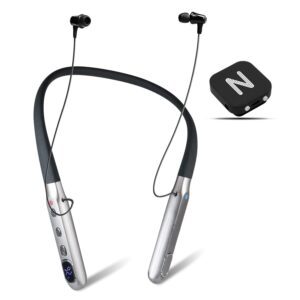 💡 Struggling to Hear Clearly in Early Stages?
For mild to moderate hearing loss, modern rechargeable hearing amplifiers can significantly improve daily sound clarity – without surgery or a prescription.
Causes of Otosclerosis
Why does this happen to some people and not others? The honest answer is: we don’t fully know. But the main contributing factors are reasonably well-established.
| Cause / Risk Factor | What We Know |
|---|---|
| Genetics | Autosomal dominant inheritance with incomplete penetrance; roughly 25% of genetic carriers develop clinical disease. Family history is the strongest predictor. |
| Sex and hormonal factors | Women are affected roughly twice as often as men. Estrogen appears to accelerate abnormal bone remodeling – which explains why pregnancy often triggers or worsens symptoms. |
| Viral factors | Measles virus RNA has been detected in otosclerotic foci. The measles vaccine has been associated with declining otosclerosis prevalence in some studies – though causation hasn’t been proven definitively. |
| Fluoride deficiency (possible) | Some evidence links low dietary fluoride to increased risk; high-fluoride water areas show lower prevalence in epidemiological data. |
One important nuance: having the gene doesn’t guarantee you’ll develop the condition. Environmental triggers seem to play a role in determining whether the gene actually “switches on.” That’s both reassuring and frustrating – it means there may be modifiable factors involved, but we can’t yet predict with certainty who will be affected.
How Otosclerosis Causes Hearing Loss
This is the part that actually matters mechanically. Healthy hearing depends on a precise chain reaction: sound waves move the eardrum, the eardrum moves three tiny bones (malleus, incus, stapes), and the stapes transmits those vibrations through the oval window into the cochlea’s fluid. The cochlea converts those fluid movements into electrical signals that the brain interprets as sound.
In otosclerosis, abnormal bone – called otospongiosis at the microscopic level – grows around the footplate of the stapes and fuses it to the oval window. The stapes literally can’t move anymore. The entire chain reaction stalls at the last relay point. Sound waves arrive, the eardrum moves, but nothing gets passed on to the inner ear. It’s like having a functioning engine with a seized transmission – the power is there, it just can’t go anywhere.
This is called conductive hearing loss – the sound conduction pathway is physically blocked, rather than the inner ear or auditory nerve being damaged. That distinction matters enormously for treatment, because conductive loss is often correctable, unlike sensorineural loss.
In some cases – particularly advanced ones – the abnormal bone growth extends into the cochlea itself, causing sensorineural hearing loss on top of the conductive component. This mixed loss is harder to treat fully and is one reason early diagnosis makes a real difference.
How Otosclerosis Is Diagnosed
Diagnosis involves combining clinical examination with audiological testing and, when needed, imaging. Here’s how it actually unfolds in practice:
- Pure-tone Audiometry The foundation of any hearing evaluation. Measures hearing thresholds across frequencies. In otosclerosis, the classic pattern is a low-frequency conductive gap with a characteristic notch at 2000 Hz on bone conduction (the Carhart notch) – a finding that’s almost diagnostic on its own when present.
- Tympanometry Assesses eardrum compliance and middle ear pressure. In otosclerosis, tympanogram is typically normal or shows reduced compliance, reflecting the stiffened ossicular chain. The acoustic reflex (stapedial reflex) is absent – the stapes can’t move to trigger it.
- Otoscopy and the Schwartz Sign The ear canal and eardrum look normal in most patients. However, in active disease, a pinkish-reddish blush may be visible through the eardrum – called the Schwartz sign (or flamingo pink sign). It reflects the increased vascularity of the active otosclerotic focus. It’s not present in everyone, but when it is, it’s a strong clinical pointer.
- CT Scan of the Temporal Bones High-resolution CT can visualize the halo of demineralization around the stapes footplate, confirming the diagnosis and providing essential surgical planning data. It’s not needed in every case but becomes important when findings are equivocal or surgery is being considered.
Treatment Options for Otosclerosis
This is where the news gets genuinely encouraging. Otosclerosis is one of those conditions where treatment options are effective, well-established, and in the surgical case, have remarkably high success rates.
🆕 Surgical – Stapedectomy / Stapedotomy
The primary and most effective treatment. The immobile stapes bone is removed and replaced with a precision prosthesis – usually titanium or Teflon – that restores the mechanical relay to the inner ear.
- Success rate: 90-95% significant hearing improvement
- Performed under local or general anesthesia
- Outpatient or short-stay procedure
- Recovery: 1-2 weeks off work; restrictions on flying and heavy exertion
- Results: most patients notice improvement within days to weeks
- Risk of complete hearing loss: approximately 1%
🎙️ Non-Surgical – Hearing Aids
Modern hearing aids are a highly effective alternative for those who prefer to avoid surgery, or where surgery carries higher risk. Today’s devices are small, programmable, and sophisticated.
- Compensates for conductive loss without correcting the underlying cause
- Best suited for mild to moderate hearing loss
- Behind-the-ear (BTE), receiver-in-canal (RIC), and invisible-in-canal (CIC) styles available
- Bluetooth connectivity in premium models
- Can be combined with surgery if mixed loss is present
💊 Sodium Fluoride (Adjunctive)
Sodium fluoride has been used to slow the progression of active otosclerosis by stabilizing bone remodeling. It’s not a cure and won’t restore lost hearing, but may limit further deterioration.
- Used primarily in active disease with the Schwartz sign present
- Evidence base is limited – not standard first-line therapy
- Combined with calcium and vitamin D supplementation
- Not suitable for everyone; discuss risks with your specialist
 💡 Improve Hearing Without Surgery
Modern Bluetooth hearing aids with noise reduction and directional microphones can meaningfully compensate for conductive hearing loss while you consider your longer-term options.
Can Otosclerosis Be Cured?
This is one of the most searched questions on the topic – and the answer is more nuanced than a simple yes or no.
Stapedectomy offers something very close to a cure for the conductive component of hearing loss. In 90-95% of cases, hearing improves significantly and the results are long-lasting. For many patients, normal or near-normal hearing is restored. That’s genuinely remarkable for a chronic progressive condition.
However – and this is important – surgery corrects the mechanical problem (the frozen stapes) but doesn’t stop the underlying disease process. Otosclerosis can potentially affect the prosthesis over time, or involve the opposite ear. A small number of patients require revision surgery years later.
For the sensorineural component, where the cochlea itself has been involved by the abnormal bone process, hearing aids or cochlear implants may be needed. Surgery alone won’t restore that portion of hearing loss.
So: not cured in the absolute sense, but treated very effectively – especially when caught early. The earlier you act, the more hearing you preserve before cochlear involvement can occur.
When to See a Doctor
If any of the following sound familiar, book an ENT appointment – not “sometime soon,” but soon:
- Gradual hearing loss in one or both ears, especially starting in your 20s-40s
- Ringing, buzzing, or low hum in the ears (tinnitus)
- Noticeably better hearing in noisy places than in quiet rooms
- Family history of progressive hearing loss or ear surgery
- Hearing loss that worsened during or after pregnancy
- Muffled speech understanding even with adequate volume
The core message is this: conductive hearing loss caused by otosclerosis is highly treatable, but the window where surgery produces optimal results is not infinite. Don’t wait until the loss is severe. Earlier intervention consistently produces better outcomes – audiologically and in terms of quality of life.
 💡 Advanced Solution for Daily Hearing Loss
If hearing loss is affecting work, relationships, or daily life, discreet in-canal hearing aids provide a more natural, invisible listening experience while you explore treatment options with your specialist.
Otosclerosis is one of those quietly consequential conditions – easy to miss, slow to progress, but significant in its impact on the texture of daily life. The good news is that medicine has genuinely good answers for it. A skilled ENT surgeon performing a stapedectomy can restore hearing that has been slowly disappearing for years. Modern hearing aids can bridge the gap while you decide. And knowing what to look for – those early, subtle otosclerosis symptoms – means you don’t have to arrive at the clinic having already lost more than necessary. Your ears are worth the attention. And so, for that matter, is the soundtrack of your life.
Frequently Asked Questions

✔️ Reviewed by Dr. Olivia Blakey, ENT Specialist (Human-Edited)
Based in London, UK – MBBS from Royal London Hospital, 10+ years in NHS & private practice.
Last reviewed: 26 October 2026
This human-edited article is reviewed regularly and updated every 6 months for medical accuracy. For personalized advice, consult a healthcare professional.


Leave a Reply